
Showing posts with label Warsaw. Show all posts
Showing posts with label Warsaw. Show all posts
Thursday, 16 January 2020

Tuesday, 30 April 2019
Sunday, 3 February 2019
Thursday, 24 January 2019
Wednesday, 23 January 2019
Saturday, 12 January 2019
Sunday, 30 December 2018
Wednesday, 3 October 2018
Sunday, 30 September 2018
Wednesday, 5 September 2018
Saturday, 14 July 2018
St. Wojciech church in Warsaw (Wola) - transitory camp
Discover the story of a transitory camp located at the St. Wojciech Church in Warsaw during the Warsaw Rising in summer 1944. Up to 90,000 inhabitants of Warsaw were detained there and later transported to Dulag 121 in Pruszków to be later deported to force labour camps or other parts of occupied Poland.
Tuesday, 5 June 2018
Saturday, 21 April 2018
The siege of Warsaw, 1939
Germans besieged the capital of Poland between 8 and 28 September 1939 in their attempt to take over the whole of the country with Blitzkrieg starting on 1 September 1939.
10,000 inhabitants of Warsaw were killed due to bombardments and further 50,000 wounded.
Warsaw was being defended by 124,000 Polish soldiers. Germans used 175,000 soldiers to encirle the city loosing 1,500 of them and having 5,000 wounded. Poles lost 2,000 soldiers with 15,000 wounded.
On 17 September Hitler order the Royal Castle of Warsaw to be bombarded. The date marks the beging of the apocalypse for Poles as on the very same day Soviets invaded Poland all along the eastern border. Having armed forced counting 1,000,000 soldiers, Poland had to fight on two fronts against 1,800,000 Germans and 600,000 Soviets.

On 25 September, Germans conducted the largest air raid with 560 tons of high explosive bombs and 72 tons of incendiary bombs being dropped. It is estimated that 1,150 sorties were flown by German aircrafts.
Luftwaffe killed 10,000 people and destroyed 10% of the city's architectural substance. The Warsaw power plant and waterworks got heavily damaged, not to mention the pearls of Polish architecture: palaces, churches and many more.
Quite interestingly Hitler did not allow to destroy the old town of Warsaw. Some historians say that he envisaged that in the future Germans would prove that Warsaw had had teutonic roots as the complex of the Old Town was erected according to Magdeburg rights with a huge square in the centre and streets surounding it.
The capitulation was signed on 28 September 1939. Dark years for Warsaw commenced with the final act of the Warsaw Rising being played in summer 1944 when Germans led to the anihilation of the city killing 200,000 civilians and 18,000 of the insurgents, forcing the remaining 650,000 to leave their homes and been expelled from their city straight to concentration camps, forced labour or becoming displaced till the end of WWII.
An american reporter Julien Bryan was the ONLY FOREIGN correspondent who remained with the people of Warsaw during the siege in September 1939. He documented the tragedy of those days.
Let us analyse some of his pictures.


The picture below is one of the most petryfing as it illustrates Balbina Szymańska with her newborn twin boys.
 It was taken in the St. Sophie Hospital where 50 mothers remained in the basement which sheltered them due to constant Luftwaffe bombardment danger. Seeing all these pain-ridden faces of young mothers...lying on the cold floor with no hope in their hearts...carryng their treasures - sweet newborns not aware of the drama all around...

The next picture shows young Ryszard Pajewski. Only 9 at that time he had suddenly been made the family breadwinner. Just one picture out of 1,300,000 dramas of 1,300,000 inhabitants of Warsaw at that time.

Other Bryan's well known pictures are also worth paying attention to:


10,000 inhabitants of Warsaw were killed due to bombardments and further 50,000 wounded.
Warsaw was being defended by 124,000 Polish soldiers. Germans used 175,000 soldiers to encirle the city loosing 1,500 of them and having 5,000 wounded. Poles lost 2,000 soldiers with 15,000 wounded.
On 17 September Hitler order the Royal Castle of Warsaw to be bombarded. The date marks the beging of the apocalypse for Poles as on the very same day Soviets invaded Poland all along the eastern border. Having armed forced counting 1,000,000 soldiers, Poland had to fight on two fronts against 1,800,000 Germans and 600,000 Soviets.

The Royal Castle of Warsaw, 17 September 1939
Picture source: Internet
On 25 September, Germans conducted the largest air raid with 560 tons of high explosive bombs and 72 tons of incendiary bombs being dropped. It is estimated that 1,150 sorties were flown by German aircrafts.
Luftwaffe killed 10,000 people and destroyed 10% of the city's architectural substance. The Warsaw power plant and waterworks got heavily damaged, not to mention the pearls of Polish architecture: palaces, churches and many more.
Quite interestingly Hitler did not allow to destroy the old town of Warsaw. Some historians say that he envisaged that in the future Germans would prove that Warsaw had had teutonic roots as the complex of the Old Town was erected according to Magdeburg rights with a huge square in the centre and streets surounding it.
The capitulation was signed on 28 September 1939. Dark years for Warsaw commenced with the final act of the Warsaw Rising being played in summer 1944 when Germans led to the anihilation of the city killing 200,000 civilians and 18,000 of the insurgents, forcing the remaining 650,000 to leave their homes and been expelled from their city straight to concentration camps, forced labour or becoming displaced till the end of WWII.
An american reporter Julien Bryan was the ONLY FOREIGN correspondent who remained with the people of Warsaw during the siege in September 1939. He documented the tragedy of those days.
Let us analyse some of his pictures.

On the picture, we may see Kazimiera Mika mourning after her sister who was killed during Luftwaffe air raid. More pictures depicting the scene might be accessed here.

The picture below is one of the most petryfing as it illustrates Balbina Szymańska with her newborn twin boys.
 It was taken in the St. Sophie Hospital where 50 mothers remained in the basement which sheltered them due to constant Luftwaffe bombardment danger. Seeing all these pain-ridden faces of young mothers...lying on the cold floor with no hope in their hearts...carryng their treasures - sweet newborns not aware of the drama all around...
The epilogue of the story is even more petryfying as 5 years later during the Warsaw Rising, Balbina Szymańska left her boys with her husband and went out to look for some food. When she got back, theire was no home. No kids. As one of the German bombs destroyed their appartment house. The boys were killed on their 5th birthday, 5 September 1944.
The next picture shows young Ryszard Pajewski. Only 9 at that time he had suddenly been made the family breadwinner. Just one picture out of 1,300,000 dramas of 1,300,000 inhabitants of Warsaw at that time.
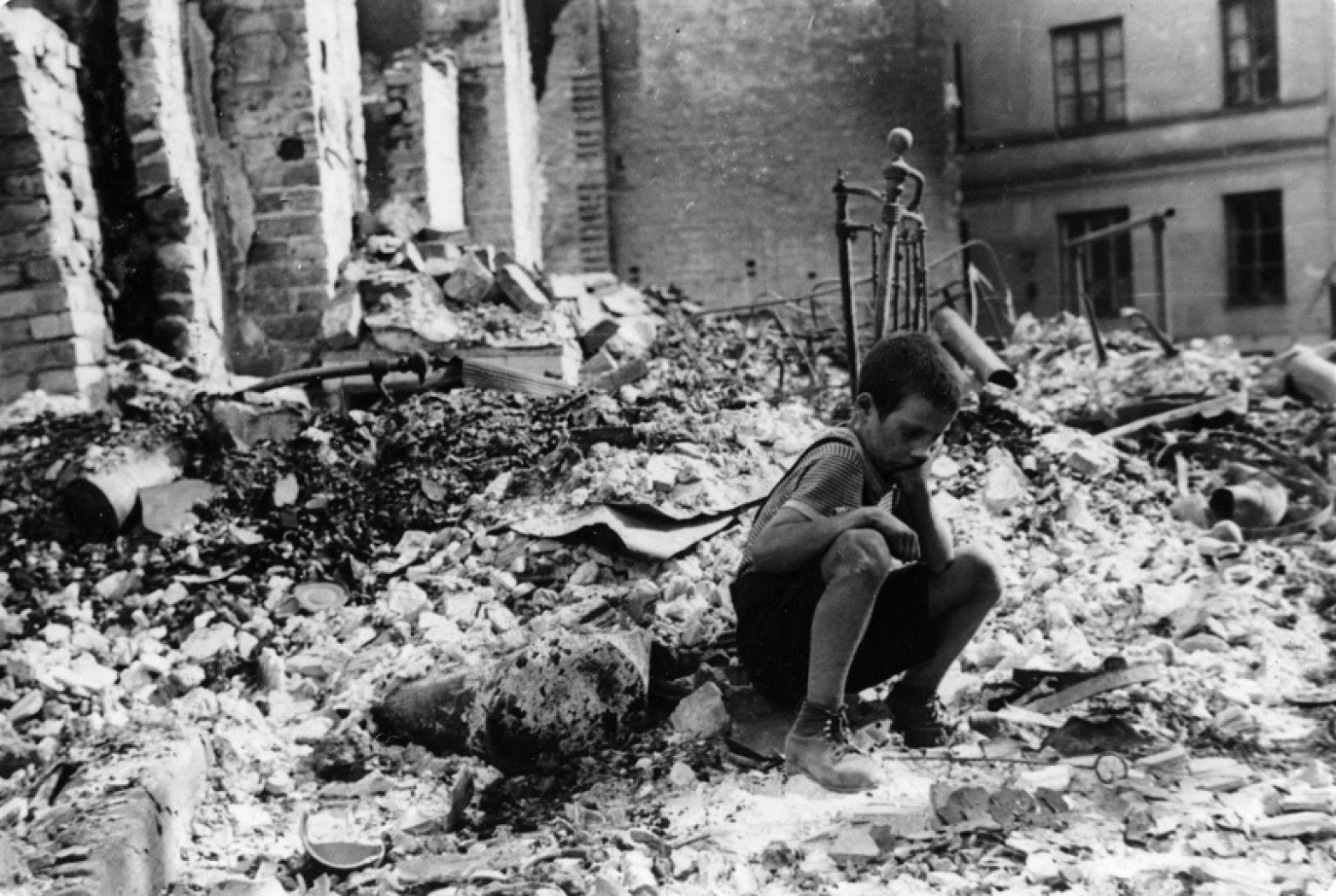
Other Bryan's well known pictures are also worth paying attention to:


Author: Julien Bryan
Images source: Internet
For a detailed report of the besieged city, watch Julien Bryan's documentary:
Source: Youtube
In total, Warsaw was torn down to foundations in 84% by Germans during WWII. 60% of its inhabitants perished. Let us look the way the capital of Poland looked like before the turmoils of the war started...
Source: Youtube
Read more:
- https://poloniuszblog.wordpress.com/2016/04/17/poland-in-1939-and-in-1959-how-i-found-the-people-id-photographed-after-20-years/ accessed on 21 April 2018
- www.warsawrising.eu (For the full acount of WWII in Warsaw with detailed look at the Warsaw Rising of 1944)
- https://ipn.gov.pl/pl/publikacje/ksiazki/27493,Kolory-wojny-Oblezenie-Warszawy-w-barwnej-fotografii-Juliena-Bryana-The-Colors-o.html

Thursday, 19 April 2018
Pacification of the Warsaw Ghetto
On 17th April 1943 German troops started the liquidation of the Jewish District of Warsaw, known as the Warsaw Ghetto. However, their plan to run it smoothly had to change as the SS units met resistance shown by a group of 1000-1500 insurgents who decided to die in an armed battle rather than being executed.
The Uprising in the Warsaw Ghetto was the first organised armed resistance in urban environment on a 'mass' scale during World War II. Therefore, Warsaw is known all across the Globe as the city of two risings against Nazi German occupants: The Uprising in the Ghetto of 1943 and the Warsaw Rising of 1944.

In April 1943 about 60,000 Jews were still residing inside the ghetto, a small portion of 460,000 who were enclosed there since the closing of the gates of the ghetto in 1940. The majority had already been deported to the Treblinka death camp (mass deportations during Aktion Reinhard in summer 1942) or fallen victim to starvation or diseases.
As for the Uprising in the Warsaw Ghetto, according to Jurgen Stroop's report, 2054 german soldiers were involved in the operation (SS, Wehrmacht and Police) and "of the total of 56,065 Jews caught, about 7,000 were exterminated within the former Ghetto in the course of the large-scale action, and 6,929 by transporting them to Treblinka, which means 14,000 Jews were exterminated altogether. Beyond the number of 56,065 Jews an estimated number of 5,000 to 6,000 were killed by explosions or in fires. The number of destroyed dug-outs amounts to 631."

Stroop underlines in his report also measures taken to stop any help from the Aryan side: "during the large-scale operation the Aryan population was informed by posters that it was strictly forbidden to enter the former Jewish Ghetto and that anybody caught within the former Ghetto without valid pass would be shot. At the same time these posters informed the Aryan population again that the death penalty would be imposed on anybody who intentionally gave refuge to a Jew, especially lodged, supported, or concealed a Jew outside the Jewish residential area."

Two organisations are known as far as military resistance is concerned, namely Żydowska Organizacja Bojowa (ŻOB, Eng. Jewish Combat Organisation) with 600 fighters and Żydowski Związek Wojskowy (ŻWZ, Eng. Jewish Military Union) with 400 fighters. The Jewish leaders of the Uprising were Mordechaj Anielewicz, Marek Edelman, Paweł Frenkel, Eliezer Geller, Leon Rodal, Dawid Wdowiński.

Read more:

The book is an unbelieveable but true story of a Polish officer, Kazimierz Moczarski, who was imprisoned by Communist regime and kept in the same cell with Jorgen Stroop, the SS commander of the liquidation of the Ghetto in Warsaw.
The story tells us also a terrible truth about the stalinist era in after-war Poland, when Polish soldiers fighting the German regime during WWII were accused and persecuted in THE SAME WAY as the Germans who were the REAL CRIMINALS OF WAR.
The Uprising in the Warsaw Ghetto was the first organised armed resistance in urban environment on a 'mass' scale during World War II. Therefore, Warsaw is known all across the Globe as the city of two risings against Nazi German occupants: The Uprising in the Ghetto of 1943 and the Warsaw Rising of 1944.

Image source: Internet
As for the Uprising in the Warsaw Ghetto, according to Jurgen Stroop's report, 2054 german soldiers were involved in the operation (SS, Wehrmacht and Police) and "of the total of 56,065 Jews caught, about 7,000 were exterminated within the former Ghetto in the course of the large-scale action, and 6,929 by transporting them to Treblinka, which means 14,000 Jews were exterminated altogether. Beyond the number of 56,065 Jews an estimated number of 5,000 to 6,000 were killed by explosions or in fires. The number of destroyed dug-outs amounts to 631."

Jorgen Stroop. The posture tells the whole story...
Image source: Stroop's Report, May 1943.

Image: A stamp released for the 70th Anniversary
of the Warsaw Ghetto Uprising
Two organisations are known as far as military resistance is concerned, namely Żydowska Organizacja Bojowa (ŻOB, Eng. Jewish Combat Organisation) with 600 fighters and Żydowski Związek Wojskowy (ŻWZ, Eng. Jewish Military Union) with 400 fighters. The Jewish leaders of the Uprising were Mordechaj Anielewicz, Marek Edelman, Paweł Frenkel, Eliezer Geller, Leon Rodal, Dawid Wdowiński.

Jews expelled from their hide-outs/dug-outs.
Image source: Stroop report, May 1943
Read more:
- http://www.jewishvirtuallibrary.org/the-stroop-report-may-1943 accessed on 19 April 2018
- Kazimierz Moczarski: "Conversations with an Executioner", 1981 ("Rozmowy z Katem", 1977)

The book is an unbelieveable but true story of a Polish officer, Kazimierz Moczarski, who was imprisoned by Communist regime and kept in the same cell with Jorgen Stroop, the SS commander of the liquidation of the Ghetto in Warsaw.
The story tells us also a terrible truth about the stalinist era in after-war Poland, when Polish soldiers fighting the German regime during WWII were accused and persecuted in THE SAME WAY as the Germans who were the REAL CRIMINALS OF WAR.
Saturday, 14 April 2018
Former Gestapo Headquarters, Warsaw
Just within an eye range, two places on the map of Warsaw overlook each other. Still nowadays the two cause thrill on the back. Why? Millions of Poles suffered indirectly because of the men who resided in those buildings and more than dozens of thousands were imprisoned, interrogated, tortured and murdered there.
Former Gestapo Headquarters now housing in its ORIGINAL interiors the Museum of Struggle and Martyrdom at Szucha Avenue, 25, Warsaw is definitely a place one needs to visit. Looking at the "tramlines' where the detained waited for their interrogation, discerning names carved into the walls...still visible as witnesses of the horrifying German occupation of Poland during WWII.


The other building, at Ujazdowskie Avenue, 11 now housing the Ministry of Justice, hides in the basement a terrible testimony of the ruling period of communists in afterwar Poland. Since 1945 there used to be the Ministry of Public Security and the basement served as jail. Unfortunately, the detained were not criminals but soldiers who fought for Poland's independence when Poland was attacked in 1939 by Germans and Soviets, who continued their fight all through the WWII as welll as Warsaw insurgents and all those who did not accept that Soviet Union took over Poland in 1944.
The Museum "Cele Bezpieki" (Eng. Stalinist Jail) opened in March 2018 houses exhibition in ORIGINAL cells and interiors of the former jail which operated here after 1945 during Communist Rule in Poland after WWII. Peep into the cells, grab a torch and discern names, pictures, letters, inscriptions carved into the walls. So much suffering in one place...
Please watch a short clip which introduces us to the exposition:
https://www.facebook.com/celebezpieki/videos/468286023569505/


 Images source: Internet
For a short video showing the exposition go here:
Read more:
Former Gestapo Headquarters now housing in its ORIGINAL interiors the Museum of Struggle and Martyrdom at Szucha Avenue, 25, Warsaw is definitely a place one needs to visit. Looking at the "tramlines' where the detained waited for their interrogation, discerning names carved into the walls...still visible as witnesses of the horrifying German occupation of Poland during WWII.


The other building, at Ujazdowskie Avenue, 11 now housing the Ministry of Justice, hides in the basement a terrible testimony of the ruling period of communists in afterwar Poland. Since 1945 there used to be the Ministry of Public Security and the basement served as jail. Unfortunately, the detained were not criminals but soldiers who fought for Poland's independence when Poland was attacked in 1939 by Germans and Soviets, who continued their fight all through the WWII as welll as Warsaw insurgents and all those who did not accept that Soviet Union took over Poland in 1944.
The Museum "Cele Bezpieki" (Eng. Stalinist Jail) opened in March 2018 houses exhibition in ORIGINAL cells and interiors of the former jail which operated here after 1945 during Communist Rule in Poland after WWII. Peep into the cells, grab a torch and discern names, pictures, letters, inscriptions carved into the walls. So much suffering in one place...
Please watch a short clip which introduces us to the exposition:
https://www.facebook.com/celebezpieki/videos/468286023569505/


For a short video showing the exposition go here:
Read more:
- http://www.projectinposterum.org/docs/chodakiewicz1.htm TRULY RECOMMENDED!
- https://www.facebook.com/celebezpieki/
- http://www.muzeum-niepodleglosci.pl/mauzoleum_szucha/
Monday, 9 April 2018
Were killed because were Poles (3) - Hanna Petrynowska
Hanna Petrynowska (codename Rana), a medical doctor, was killed by SS soldiers who attacked a field hospital which was hidden in the building of PWPW (Polish Security Printing Works) on 28 August 1944. She is said to have disregarded SS order to finish surgery and was executed as a result together with her patients.
She was a sister of Jan Żabiński, who saved 300 Jews as the Director of Warsaw Zoo during German occupation of the capital of Poland. The story was filmed in 2017 in "Zookeeper's Wife' starring Jessica Chastain as Antonina Żabińska, Jan's wife.
Hanna's and Jan's biographies serve as a good example of the Polish response to the evil imposed by German occupants.
They were engaged, not idle in watching all those crimes commited by the German invaders. As for Hanna, she paid with her life for resisting the forces who aimed at the anihilation of Poland and its people during WWII.
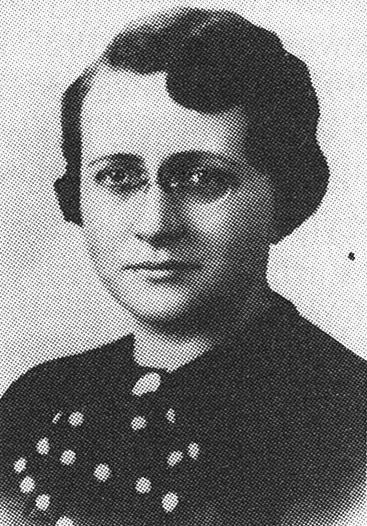
Analysing her life it should be noted that Hanna Petrynowska became pediatrician in 1924 and in 1940 started her work as an in-house doctor in PWPW just right after the imprisonment of her husband who had held that function earlier on. Her husband, Marian Petrynowski was sent to Mauthausen concentration camp and never came back. She started to use codename "Rana" (Eng. wound) after Marian's death in KL Mauthausen.
She was decorated with V class Virtuti Militari Cross posthumously.
She was a sister of Jan Żabiński, who saved 300 Jews as the Director of Warsaw Zoo during German occupation of the capital of Poland. The story was filmed in 2017 in "Zookeeper's Wife' starring Jessica Chastain as Antonina Żabińska, Jan's wife.
Hanna's and Jan's biographies serve as a good example of the Polish response to the evil imposed by German occupants.
They were engaged, not idle in watching all those crimes commited by the German invaders. As for Hanna, she paid with her life for resisting the forces who aimed at the anihilation of Poland and its people during WWII.
Hanna Petrynowska
Image source: Internet
Analysing her life it should be noted that Hanna Petrynowska became pediatrician in 1924 and in 1940 started her work as an in-house doctor in PWPW just right after the imprisonment of her husband who had held that function earlier on. Her husband, Marian Petrynowski was sent to Mauthausen concentration camp and never came back. She started to use codename "Rana" (Eng. wound) after Marian's death in KL Mauthausen.
She was decorated with V class Virtuti Militari Cross posthumously.
Source: Youtube
Read more:
- https://www.pwpw.pl/en/Redoubt/Redoubt.html accessed on 9 April 2018
- https://sprawiedliwi.org.pl/en/stories-of-rescue/story-rescue-zabinski-family accessed on 9 April 2018
- http://lekarzepowstania.pl/osoba/hanna-zabinska-petrynowska/ accessed on 9 April 2018
Thursday, 29 March 2018
Were killed because were Poles (1) - Stefan Bryła
One of the most well-known photographs depicting the Warsaw Rising in 1944 shows the highest sky-skraper of the time - The Prudencial building being hit by German artillery's Karl-Geraet 2- ton missile. There are so many stories hidden behind the picture...
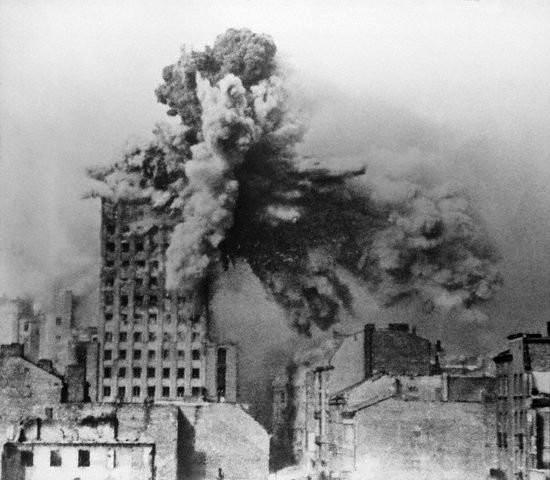
Let us plunge into those times and start with the story of the architect of the building Stefan Bryła. He planned such a great steel construction for Prudential that heavy bombardments and the fact that it was struck by a 2-ton missile did not destroy the building. Bryła (born in 1886) was a professor at the Polish universities in Lwów and Warsaw. He continued his work in conspiracy teaching future adepts of architecture during WWII, which led to his imprisonment and execution. As he was a pioneer in welding steel structures technology (the constructor of the very first road welded bridge in the world), Germans counted on him being 'useful' to the them. However he prefered to be executed rather than serve the Third Reich. He was one of the victims of the mass public executions in the streets of Warsaw which were held during German occupation of the city during WWII (executed on 3 december 1943).

Prudential Building, 28 August 1944, photo by Sylwester Braun "Kris"
Let us plunge into those times and start with the story of the architect of the building Stefan Bryła. He planned such a great steel construction for Prudential that heavy bombardments and the fact that it was struck by a 2-ton missile did not destroy the building. Bryła (born in 1886) was a professor at the Polish universities in Lwów and Warsaw. He continued his work in conspiracy teaching future adepts of architecture during WWII, which led to his imprisonment and execution. As he was a pioneer in welding steel structures technology (the constructor of the very first road welded bridge in the world), Germans counted on him being 'useful' to the them. However he prefered to be executed rather than serve the Third Reich. He was one of the victims of the mass public executions in the streets of Warsaw which were held during German occupation of the city during WWII (executed on 3 december 1943).
Stefan Bryła
Images source: Internet
As for the Warsaw Rising, the Prudential Building was taken over Polish insurgents on the very first day of the Rising i.e. 1 August 1944. Polish white and red national flag was placed on the top. Ahead of two months of heavy fighting, terrible bombardments and German war crimes on civilians.
For more information on Warsaw Rising visit www.warsawrising.eu and the Warsaw Rising Museum: www.1944.pl/en/
Wednesday, 28 February 2018
Public execution of prisoners of the Pawiak prison in Warsaw (1942)
 |
| Execution in Rembertów / Warsaw |
- next to the level crossing, at Mszczonowska Street, Wola District;
- close to the Szczęśliwce Depot;
- in Toruńska Street (on the corner of Wysockiego Street), on Pelcowizna;
- next to the train station in Rembertów;
- close to the tracks of the railway in Marki;
On October 16th, notices appeared on the walls of Warsaw, signed by dr Ludwig Hahn - SD and the police security commander for the Warsaw District. The notices reported that "fifty communists" had been hanged in retaliation for blowing up the railway tracks near the town.
Public execution made a big impression on the inhabitants of Warsaw. Crowds of people gathered under the gallows. Many of them tried to verify whether there weren't any of their relatives or friends among the victims. In the evening the convicts' bodies were removed from the gallows. At night Germans secretly buried the twenty bodies of those executed on the "Skra" pitch, and the remaining bodies - on the nearby Jewish cemetery, at Okopowa Street.
Line
Subscribe to:
Posts (Atom)